 5. Girl with a Pearl Earring by Vermeer January
This is a plain portrait of a girl, probably before her marriage. The lack of background and color displays tears drop pearl earrings. 4. Luncheon of the Boating Party by Pierre Auguste Renoir
The painting depicts a group of Renoir's friends relaxing on the balcony along the Seine River. In this painting Renoir has captured the joy of the middle class of late 19th-century France, this is a painting of life that brings happiness and joy to any room.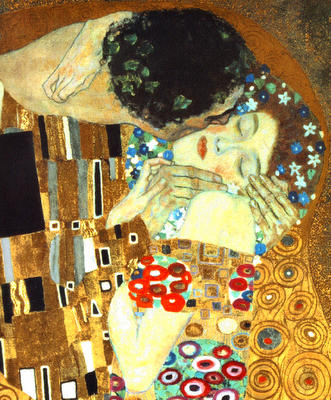 3. The Kiss by Gustav Klimt
Gustav Klimt, the Vienna master painted the painting Kiss in 1907. This painting illustrates some surrounded by a gold blanket and ornaments share a passion when sliding - the perfect kiss. 2. Starry Night by Vincent Van Gogh
One painting that is currently best known, Van Gogh's Starry Night is a classic painting that calls the emotions of peace in the church tower to the wild abandon of color used for the sky that night. 1. Mona Lisa by Leonardo Da Vinci
Mona Lisa, the world's most famous painting, owned by the French government and hangs in the Louvre in Paris. The painting shows a woman looking at viewer with what is often described as "enigmatic smile". Mona Lisa is probably the most famous in the history of art; several other works of art are as romantic, celebrated, or reproduced.
Read More...
Monday, October 10, 2011
10 World's Most Famous Painting (part 2)

10 World's Most Famous Painting (part 1)

Georgia O'Keefe spent her days at Lake George, New York in the early 1900s, which has inspired much of his work. This painting shows the gentle waves and ripples of Lake George.
 9. The Persistence of Memory by Salvador Dali
Perhaps the most famous painting by Salvador Dali, The Persistence of Memory was created in 1931 and now displayed at the Museum of Modern Art in New York City. Dali introduced the melting pocket watches in this sheet. You also can see in the middle of painting the human figure.
 8. The Dream by Pablo Picasso
Pablo Picasso pioneered the modern art movement called Cubism and is widely recognized as the most important artists of the 20th century.
 7. Corner of the Garden at Montgeron by Claude Monet
This famous painting by Monet was originally created in 1877. Known as the classic Impressionist Monet. At Angle Park in Montgeron, Monet has captured the ever-changing nature of light and color.
 6. Café Terrace at Night by Vincent Van Gogh
In this painting Van Gogh depicts a cafe in Arles, then Cafe Terrace and today it is called Cafe van Gogh. Unique style of painting to Van Gogh with warm colors and depth of perspective Read More...
Photography
Throughout the 19th century, photography was used for many different purposes. Photography was used for the first time for the photographic police files after the overthrow of the Paris Commune (1871). Scientists Muybridge and Marey used photography to break down movement. Painter Degas made use of photographs for his paintings. A great number of unknown photographers set up their shops and produced posed portraits, and explorers compiled albums of pictures taken in distant lands. Photography was ideally suited to recording the problems of modern life. One who contributed importantly to its rich documentary tradition was Eugene Atget. But photographers consistently espoused the idea that photography was an art. They shared the belief that photography was a set of physical and chemical operations in which the artist played a key part by measuring, filtering and softening matter, shade and light, and specially by choosing subjects and settings. In the 1890s in Europe and the United States, these photographers were known as pictorialists - they were retouching their works with brushes. Photography is the art, science and practice of creating durable images by recording light or other electromagnetic radiation, either electronically by means of an image sensor or chemically by means of a light-sensitive material such as photographic film.[1] Typically, a lens is used to focus the light reflected or emitted from objects into a real image on the light-sensitive surface inside a camera during a timed exposure. The result in an electronic image sensor is an electrical charge at each pixel, which is electronically processed and stored in a digital image file for subsequent display or processing. The result in a photographic emulsion is an invisible latent image, which is later chemically developed into a visible image, either negative or positive depending on the purpose of the photographic material and the method of processing. A negative image on film is traditionally used to photographically create a positive image on a paper base, known as a print, either by using an enlarger or by contact printing. In the early years of the twentieth century, the American photographers Edward Steichen and Alfred Stieglitz responded to this movement of pictorialists by advocating a return to a pure form of photography, with no interference other than framing the subject. The magazine Camera Work contributed to the dissemination of photographs in this school, such as the pictures of Paul Strand. Soon after photography had been born in the early 1830s, endless discussions whether photography was an art or a technique began. For some, the birth of photography foretold the end of painting, drawing, lithography, engravings and prints, but many artists maintained that a machine could never produce a work of art.